by RMLS Communication Department | Jun 18, 2009
One of the most interesting statistics I saw in the latest issues of Market Action was the increase of pending sales compared to May 2008 in Clark County. This was the second month in a row that the number of pending sales rivaled that of the same time period a year ago. This is good news! But what caught me by surprise was that the number of closed sales is still down from the same time a year ago.
So I started to wonder:
1) On average how long does it take for pending listings to show up as sold? According to the National Association of Realtors® pending home sales typically “become existing-home sales one-to-two months later.”
2) What percentage of accepted offers fail these days? Using a formula that I got from my new friend Chuck Reiling, a real estate professional in Seattle, WA, I took a stab at calculating the fallouts for properties in Clark County.
Following Chuck’s formula I looked at the pending listings monthly from May 1, 2007 to May 31, 2009 and the closed sales from June 1, 2007 to May 31, 2009. Like Chuck I staggered the pendings by one month to allow for a “typical” close time and I used a two month running average to adjust for variances.
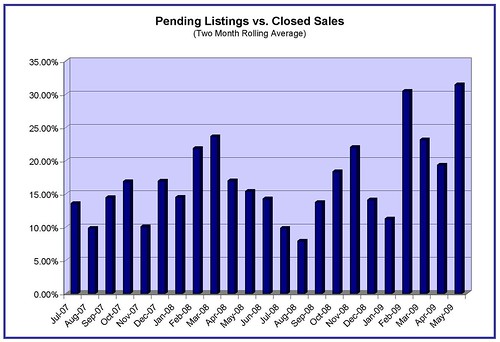
Here’s a graph of the ratios:
The average pending vs. closed sale ratio is 17 percent. You’ll notice that the last few months have all been above that rate, with May 2009 coming in at 31.4 percent (the highest so far).
According to Eric Newman, a Mortgage Banker with Summit Mortgage Corp, these numbers may not actually reflect sale fails, but rather sale delays. Newman says that these days there are a number of factors that increase closing time, from waiting on bank approval when needed (approximate average of three weeks) to overwhelmed underwriters (current response time for FHA loans is around 21 days).
For example, I did a quick search in RMLSweb and discovered that out of the 552 properties that went pending in Clark County in April, approximately 117 were marked as requiring 3rd party approval (not all of these listings are short sales, but most of them are) and 122 were listed as bank owned. That’s almost half of the pending listings – 43 percent.
While it’s likely that a percentage of these more complicated transactions do fail, it also may be that these listings take longer to close so the typical one month lag may not apply. Newman says we would expect that most of those pending listings will probably not be recorded as closed until June because many loans are taking 45 to 60 days to close in the current market.
What do you think? What are you seeing out in the field?
by RMLS Communication Department | Jun 17, 2009
For a summary of the National Association of Realtors® recommended changes that were approved by the RMLS™ Board of Directors click here. These changes go into effect July 1.
by RMLS Communication Department | Jun 15, 2009
Later this month we will be adding mapping to several searches in RMLSweb including Advanced Search and Prospecting. This will allow you to choose between searching via custom Map Ranges or Area Numbers in the future.
To schedule a training session on this new release, call your local RMLS™ office, or e-mail training@rmls.com.
by RMLS Communication Department | Jun 11, 2009
Rumor has it that first time buyers (thanks to the $8000 tax credit) and investors are making the bulk of home purchases these days. Like all savvy shoppers, I’m sure they want to make sure they are getting a good deal.
While, ultimately this is extremely personal calculation (because it depends on the buyer’s income, mortgage rates, how well the house will meet their needs, etc.) there is one generic indicator that we can use to get a sense of where the market is at overall: the Affordability Index.
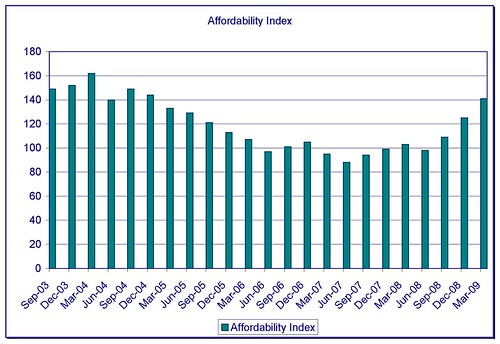
This graph shows the affordability index for the Portland Metro Area by quarter since Sept. 2003.
According to our calculations (which are based on a formula we got from the National Association of Realtors a while back) houses have been becoming increasingly more affordable since September 2008. But what does that mean?
Let’s look at the index rating for April, which was 1.41 (see graph above). In theory, someone making the median family income $70,000 according to HUD (surprisingly it’s up this year) would earn 41 percent more money than they would need to be able to afford the monthly payment on the median priced home in the Portland Market ($246, 400 according to the April 2009 Portland Market Action–of course).
That is IF they got a loan at the 4.81 percent average interest rate per Freddie Mac in April AND they had a 20 percent down payment (which we all know isn’t all that common for first time home buyers these days).
Question is: what will happen now that interest rates are starting to creep back up? We’ll let you know in the July issue of Market Action—that’s the next time we calculate and report affordability in the newsletter.
by RMLS Communication Department | Jun 10, 2009
We sometimes get reports of homes being entered into RMLSweb as detached homes, when they are in fact, attached (or vice versa). We realize this can be confusing at times, so let’s briefly review the attached v. detached question.
Let’s start with the textbook definitions:
“Attached: An element of the residence’s construction (such as a wall, ceiling, or floor) is shared with another property. Condominiums excluded.”
“Detached: A stand-alone residence, excluding manufactured homes, for which the sale includes the land on which the residence is located.”
Now – remember how your teachers would have you come up with acrostic poems? It’s when you take each letter of your name or a word & you have to use it as the first letter in each line of the poem (here are instructions on how to write an acrostic poem… in case you wanted to know).
We came up with one each for Attached & Detached houses to help you remember the difference!
ATTACHED:
Adjoined
To
Things, such
As
Ceilings and walls of other
Houses,
Especially
Duplexes
DETACHED:
Disconnected from
Everyone, especially from
Those
Adjacent buildings,
Construction, and
Housing. But, connected to
Earth and
Dirt
Ok, I’m aware that acrostic poems probably won’t be particularly helpful in remembering what’s attached v. detached, but just let this silly attempt at a mnemonic device serve as a reminder to be cogniscent cognizant of the issue when entering listings. And if you’re ever unsure, feel free to give us a call!